
InfuLife® Pumps › Chemotherapy
InfuLife® Elastomeric Infusion Pump for Chemotherapy
Low-flow InfuLife® pumps deliver chemotherapy continuously for 25 to 270 hours, so adult cancer patients can receive their infusion at home, in the hospital or at alternate sites. No batteries or electronics.
FDA 510(k) cleared, K240624 · Rx only · Manufactured in compliance with ISO 13485:2016 · Conforms to EU MDR 2017/745, TIR101:2021 and ISO 28620-2020
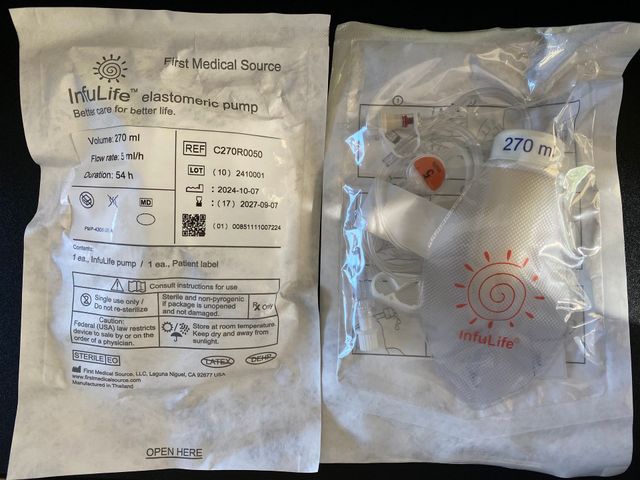
InfuLife® for chemotherapy at a glance
Models for chemotherapy
Low-flow models, accuracy ±12%. Nominal delivery time = volume ÷ flow rate. Fill volume = volume to infuse + about 5 mL residual; the fill volume chart (PMP-1103) covers other infusion times.
| Model | Volume (mL) | Flow rate (mL/h) | Nominal time | Time variance (±) |
|---|---|---|---|---|
| Low flow: chemotherapy and pain management (±12%) | ||||
| C100R0005 | 100 | 0.5 | 200 h | 24 h |
| C100R0010 | 100 | 1 | 100 h | 12 h |
| C100R0015 | 100 | 1.5 | 66.7 h | 8 h |
| C100R0020 | 100 | 2 | 50 h | 6 h |
| C120R0020 | 120 | 2 | 60 h | 7.2 h |
| C120R0040 | 120 | 4 | 30 h | 3.6 h |
| C125R0050 | 125 | 5 | 25 h | 3 h |
| C270R0010 | 270 | 1 | 270 h | 32.4 h |
| C270R0020 | 270 | 2 | 135 h | 16.2 h |
| C270R0040 | 270 | 4 | 67.5 h | 8 h |
| C270R0050 | 270 | 5 | 54 h | 6.5 h |
| C270R0100 | 270 | 10 | 27 h | 3.3 h |
| C300R0020 | 300 | 2 | 150 h | 18 h |
| C400R0040 | 400 | 4 | 100 h | 12 h |
| C400R0050 | 400 | 5 | 80 h | 9.6 h |
| C400R0100 | 400 | 10 | 40 h | 4.8 h |
Preparing and giving chemotherapy with InfuLife®
Pharmacy
- Fill with a syringe or other filling device; filling requires 50% less effort.
- Fill volume = volume to infuse + about 5 mL residual.
- Dosage is adjusted through the drug concentration; the flow rate is fixed.
- Flow rates are based on 0.9% sodium chloride. Other diluents may change them; 5% dextrose gives about 10% longer delivery.
- Can be started right after filling. A filled pump stored more than 8 hours before starting may run about 10% longer.
Nursing
- To minimize exposure to hazardous medication, prime by pinching the tubing at the pump inlet, removing the distal end cap and priming the set with saline from a syringe.
- Keep the flow controller against the skin, and the pump level with the access site.
- With a central or peripheral catheter, follow the catheter manufacturer's instructions.
- Staff competency assessment available (PMP-1104).
At home
- The carry pouch goes on a belt during the day and can hang at the bedside at night.
- There is no alarm. The balloon gets smaller as the medication is infused.
- Keep the pump at the same height as the access site, and don't heat it or put it under a blanket: warmer pumps infuse faster, colder ones slower.
- Not for use while bathing or swimming; showering is fine if the pump and access site are protected from water.
- If it doesn't seem to be working, check that all clamps are open and the tubing isn't kinked, then call the provider.
- Patient guide included (PMP-1102).
Working with fluorouracil (5-FU)
Some drugs, such as fluorouracil (5-FU), can precipitate and crystallize in the pump tubing or filter, which could cause a partial or no-flow condition. Cold temperature, high concentration and time at rest make it more likely.
- Protect pumps containing 5-FU from cold temperatures during transport.
- Tell patients not to refrigerate pumps with 5-FU or expose them to cold during the infusion.
- Dilute the drug unless contraindicated.
- Don't let a pre-filled pump sit too long.
- Follow the drug manufacturer's recommendations for storage and transport.
The drug stability reference (PMP-1107B) lists data for fluorouracil (5-FU).
Questions about InfuLife® for chemotherapy
How long does a chemotherapy infusion take?
The nominal delivery time is the volume divided by the flow rate: 25 to 270 hours across the low-flow models, within ±12%. Temperature, head height, fill volume and the solution's viscosity can make it shorter or longer; see the Instructions for Use.
Can a filled pump go in the refrigerator?
Filled pumps can be stored in the refrigerator, never the freezer, and must reach room temperature before use: about 2 to 3 hours for 100 to 125 mL, 3 to 4 hours for 270 to 300 mL, and 4 to 5 hours for 400 mL. Pumps containing 5-FU should not be refrigerated.
Does the pump have an alarm?
No. InfuLife has no batteries or electronics, so there is no alarm or alert if the flow stops, and it is not recommended for life-supporting medications. The balloon gets smaller as the medication is infused; the markings on the soft cover give only a general indication of what is left.
Can patients with a latex allergy use InfuLife®?
Yes. InfuLife® is not made with natural rubber latex or DEHP.
Can a patient have an MRI while connected?
Yes. InfuLife® has no metal or electronic parts and is MR safe.
What can't be infused with InfuLife®?
Blood and blood products, insulin, critical or life-supporting medications, total parenteral nutrition (TPN), lipids or fat emulsions, and any solution that is not compatible with the fluid path materials. See the Instructions for Use for all contraindications.
Documents
How to order
InfuLife® pumps are distributed by RWM.
Questions about models, availability or in-service training: sales@firstmedicalsource.com
More InfuLife® uses
Indications for Use
InfuLife is indicated for delivery of antibiotics, chemotherapy, and pain management, as directed by a physician or licensed healthcare professional. Routes of administration include intravenous, intra-arterial, subcutaneous, intramuscular, and epidural. Additionally, InfuLife is indicated for continuous and/or intermittent delivery of medication, such as local anesthetics or narcotics, to surgical wound sites and/or proximity to nerves for preoperative, perioperative, and postoperative regional anesthesia and pain management.
Intended patient populations: InfuLife is intended for use by adult patients, and children weighing more than 20 Kg.
Contraindications: InfuLife is contraindicated for intra-articular infusion of anesthetics and for infusion of blood and blood products, infusion of insulin, infusion of critical or life-supporting medications, infusion of any solution that is not compatible with the fluid path materials; and use in ambulatory regimens by patients not capable of self-administering their therapy or not under the care of a responsible individual. InfuLife is contraindicated for use on neonates, infants, and children weighing less than 20 Kg due to potential exposure to EO residuals.
CAUTION: FMS pumps are contraindicated for intra-articular use. There is an inherent risk in using any medical device. Please refer to the product labeling for Indications, Cautions, Warnings and Contraindications. Failure to follow the product labeling may directly impact patient safety. Physicians are responsible for prescribing and administering medications per instructions provided by the drug manufacturers.
InfuLife® is cleared for distribution in the USA under the 510k K240624. Federal law restricts these devices to sale by or on the order of a licensed healthcare practitioner. Rx only. See the Instructions for Use for complete warnings, contraindications and precautions.