
InfuLife® Pumps › Pain management
InfuLife® Elastomeric Pain Pump
Continuous and/or intermittent delivery of local anesthetics or narcotics to surgical wound sites and near nerves, before, during and after surgery. Silent, with no batteries or electronics.
FDA 510(k) cleared, K240624 · Rx only · Manufactured in compliance with ISO 13485:2016 · Conforms to EU MDR 2017/745, TIR101:2021 and ISO 28620-2020
InfuLife® for pain management at a glance
Where InfuLife® is used for pain management
Surgical wound sites
- Continuous and/or intermittent delivery of local anesthetics or narcotics to the surgical wound site.
- Before, during and after surgery.
Near nerves
- Delivery of local anesthetics near nerves for preoperative, perioperative and postoperative regional anesthesia.
- Low-flow rates from 0.5 to 10 mL/h, ±12%.
Epidural and other routes
- Routes of administration include intravenous, intra-arterial, subcutaneous, intramuscular and epidural.
- Epidural infusion of analgesics is limited to specifically designed epidural catheters.
Warnings for pain management (from the Instructions for Use)
- For use only by trained clinicians.
- Intravenous or intra-arterial injection of local anesthesia drugs may cause toxicity and possible cardiac arrest.
- Do not use for intra-articular infusion of local anesthetics.
- Devices used for epidural infusion must be clearly differentiated from all other infusion devices.
- There is no alarm when the flow stops, and the scale on the cover gives only a general indication of the remaining volume; use caution where over-delivery of medications could result in serious injury or death.
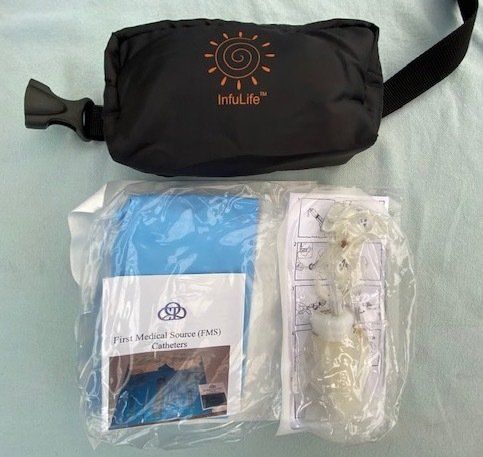
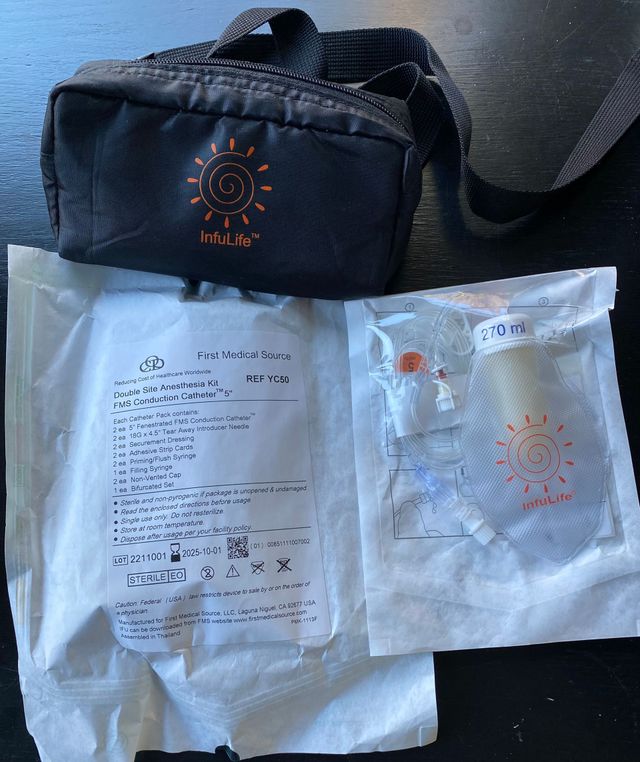
FMS Anesthesia Kits
Reliable, ready to Use, Sterile Local Anesthesia Catheter Kits and infusion pumps. FMS kits have been in the US market since 2010.
FMS kits are available with single and dual 5" catheters for 2 day (5 ml/hr) or 5 day (2 ml/hr) infusions. For additional models and availability, please contact First Medical Source.
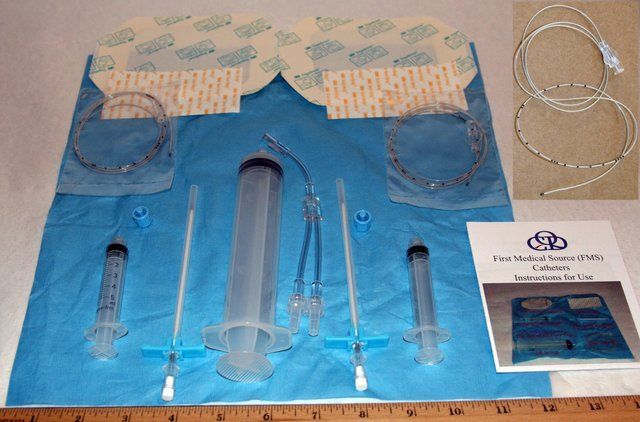
Double Site Anesthesia Kit, FMS Conduction Catheter 5" REF YC50. Each Catheter Pack contains:
- 2 ea 5" Fenestrated FMS Conduction Catheter™
- 2 ea 18G x 4.5" Tear Away Introducer Needle
- 2 ea Securement Dressing
- 2 ea Adhesive Strip Cards
- 2 ea Priming/Flush Syringe
- 1 ea Filling Syringe
- 2 ea Non-Vented Cap
- 1 ea Bifurcated Set
- 1 ea Instructions for Use
Models for pain management
Low-flow models, accuracy ±12%. Nominal delivery time = volume ÷ flow rate. FMS kits use 5 mL/h (2-day) or 2 mL/h (5-day) infusions.
| Model | Volume (mL) | Flow rate (mL/h) | Nominal time | Time variance (±) |
|---|---|---|---|---|
| Low flow: chemotherapy and pain management (±12%) | ||||
| C100R0005 | 100 | 0.5 | 200 h | 24 h |
| C100R0010 | 100 | 1 | 100 h | 12 h |
| C100R0015 | 100 | 1.5 | 66.7 h | 8 h |
| C100R0020 | 100 | 2 | 50 h | 6 h |
| C120R0020 | 120 | 2 | 60 h | 7.2 h |
| C120R0040 | 120 | 4 | 30 h | 3.6 h |
| C125R0050 | 125 | 5 | 25 h | 3 h |
| C270R0010 | 270 | 1 | 270 h | 32.4 h |
| C270R0020 | 270 | 2 | 135 h | 16.2 h |
| C270R0040 | 270 | 4 | 67.5 h | 8 h |
| C270R0050 | 270 | 5 | 54 h | 6.5 h |
| C270R0100 | 270 | 10 | 27 h | 3.3 h |
| C300R0020 | 300 | 2 | 150 h | 18 h |
| C400R0040 | 400 | 4 | 100 h | 12 h |
| C400R0050 | 400 | 5 | 80 h | 9.6 h |
| C400R0100 | 400 | 10 | 40 h | 4.8 h |
The drug stability reference (PMP-1107B) lists data for lidocaine.
Starting and using the pain pump
Nursing
- Prime by opening the clamp until all air is expelled, then close it.
- Start by attaching to the access device and opening the clamp.
- Tape 2 to 3 inches of the flow control tubing to the patient's skin, and keep the pump level with the access site.
- Staff competency assessment available (PMP-1104).
Pharmacy
- Fill volume = volume to infuse + about 5 mL residual.
- Dosage is adjusted through the drug concentration; the flow rate is fixed.
- Can be started right after filling.
- When refrigerated (6 to 8 °C), reaches room temperature (23 °C) in 2 to 5 hours.
At home
- The carry pouch goes on a belt during the day and can hang at the bedside at night.
- There is no alarm. The balloon gets smaller as the medication is infused.
- Keep the pump at the same height as the access site, and don't heat it or put it under a blanket: warmer pumps infuse faster, colder ones slower.
- Not for use while bathing or swimming; showering is fine if the pump and access site are protected from water.
- If it doesn't seem to be working, check that all clamps are open and the tubing isn't kinked, then call the provider.
- Patient guide included (PMP-1102).
Questions about the InfuLife® pain pump
Can InfuLife® be used for epidural infusion?
Epidural is one of the indicated routes of administration. Epidural infusion of analgesics is limited to specifically designed epidural catheters, and the pump must be clearly differentiated from all other infusion devices.
Can InfuLife® be used in a joint?
No. InfuLife® is contraindicated for intra-articular infusion of anesthetics.
How long does a pain pump infusion last?
FMS anesthesia kits are available for 2-day (5 mL/h) or 5-day (2 mL/h) infusions. Across the low-flow models, nominal delivery times run from 25 to 270 hours, within ±12%.
Does the pump have an alarm?
No. InfuLife has no batteries or electronics, so there is no alarm or alert if the flow stops, and it is not recommended for life-supporting medications. The balloon gets smaller as the medication is infused; the markings on the soft cover give only a general indication of what is left.
Can patients with a latex allergy use InfuLife®?
Yes. InfuLife® is not made with natural rubber latex or DEHP.
Can a patient have an MRI while connected?
Yes. InfuLife® has no metal or electronic parts and is MR safe.
What can't be infused with InfuLife®?
Blood and blood products, insulin, critical or life-supporting medications, total parenteral nutrition (TPN), lipids or fat emulsions, and any solution that is not compatible with the fluid path materials. See the Instructions for Use for all contraindications.
Documents
How to order
InfuLife® pumps are distributed by RWM.
Questions about models, availability or in-service training: sales@firstmedicalsource.com
More InfuLife® uses
Indications for Use
InfuLife is indicated for delivery of antibiotics, chemotherapy, and pain management, as directed by a physician or licensed healthcare professional. Routes of administration include intravenous, intra-arterial, subcutaneous, intramuscular, and epidural. Additionally, InfuLife is indicated for continuous and/or intermittent delivery of medication, such as local anesthetics or narcotics, to surgical wound sites and/or proximity to nerves for preoperative, perioperative, and postoperative regional anesthesia and pain management.
Intended patient populations: InfuLife is intended for use by adult patients, and children weighing more than 20 Kg.
Contraindications: InfuLife is contraindicated for intra-articular infusion of anesthetics and for infusion of blood and blood products, infusion of insulin, infusion of critical or life-supporting medications, infusion of any solution that is not compatible with the fluid path materials; and use in ambulatory regimens by patients not capable of self-administering their therapy or not under the care of a responsible individual. InfuLife is contraindicated for use on neonates, infants, and children weighing less than 20 Kg due to potential exposure to EO residuals.
CAUTION: FMS pumps are contraindicated for intra-articular use. There is an inherent risk in using any medical device. Please refer to the product labeling for Indications, Cautions, Warnings and Contraindications. Failure to follow the product labeling may directly impact patient safety. Physicians are responsible for prescribing and administering medications per instructions provided by the drug manufacturers.
InfuLife® is cleared for distribution in the USA under the 510k K240624. Federal law restricts these devices to sale by or on the order of a licensed healthcare practitioner. Rx only. See the Instructions for Use for complete warnings, contraindications and precautions.